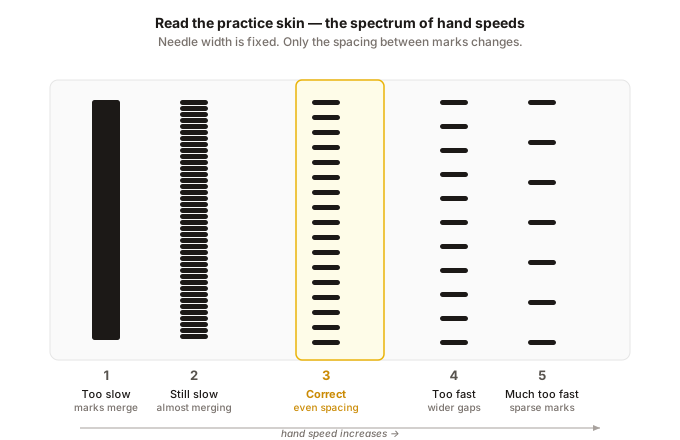
Key Points#
- Feathering is depth control, not speed control. The needle leaves the dermis gradually because the machine depth changes — not because your hand moves faster.
- When most artists try to feather a shading stroke, the hand speeds up on its own. That instinct is borrowed from whip shading, where speed is the tool. In smooth shading it is the wrong tool.
- Speeding up on exit does not soften the stroke. It drags the needle sideways while it is still at full depth, and that leaves horizontal needle marks.
- Those marks are permanent. A second pass does not blend them out — it only adds pigment around them and can cause the shade to be darker than expected, yet still not smooth.
- The fix is to be aware of the depth control: using a sweeping motion to help change the depth of the needle in the skin.
You are shading a soft gradient. You reach the end of a stroke, you want it to fade out to nothing, so — without deciding to — your hand picks up speed on the way out. It feels right. A faster exit feels like it should give a lighter, softer end.
It does not. That sped-up exit is the single most common way I see shading go wrong, and it is worth understanding exactly why, because the marks it leaves cannot be fixed later.
The short version: feathering is a depth skill, and you just tried to solve it with speed.
Another short version: the feathering skill for smooth shading is not the same as the whip shading skill for liners, even though they look similar.
Why the hand speeds up on its own#
Most artists who speed up on exit are not being careless. They are borrowing a motion from the habit of using a liner, typically from whip shading.
In whip shading, hand speed is the tool. You flick the machine across the skin, and lines become dots — a faster flick lays a lighter tone. If you have used a liner for a while or ever practiced whip shading, your body has learned that "lighter end of a stroke" and "move faster" belong together.
So when you switch to smooth shading and you want a light, fading tail, your hand offers you the tool it already owns. It speeds up. The instinct is reasonable. It is also pointed at the wrong variable.
Here is the pattern I see most often — drawn from a composite of apprentices over 10 years, not one specific student. An apprentice has spent a month getting confident, clean lines and just moved into shading. They want a stroke that tapers off softly, their hand reaches for the closest motion it knows, and out comes a fast exit. They are running a whip-shading reflex inside a technique that does not use it.
What feathering actually controls#
Here is a quick primer before the mechanism. The needle deposits stable, healed pigment only when it reaches the dermis — the middle layer of skin. Think of "full working depth" as the needle sitting properly in the dermis, and "zero depth" as the needle just grazing the surface. Feathering is the act of traveling between those two, gradually, at the start or the end of a stroke.
Here is the part that matters. That travel between full depth and zero depth is controlled by the depth of the machine in the skin — not by how fast your hand moves across it.
Picture a loaded paintbrush leaving the paper at the end of a stroke. There are two clean ways to do it, and the difference between them is the whole lesson. Lift the brush straight up off the paper and you get an abrupt blob where it stops. Or sweep the brush off along a shallow arc, at the same hand speed the whole time, and the stroke simply tapers to nothing. Only the second one is a feather.
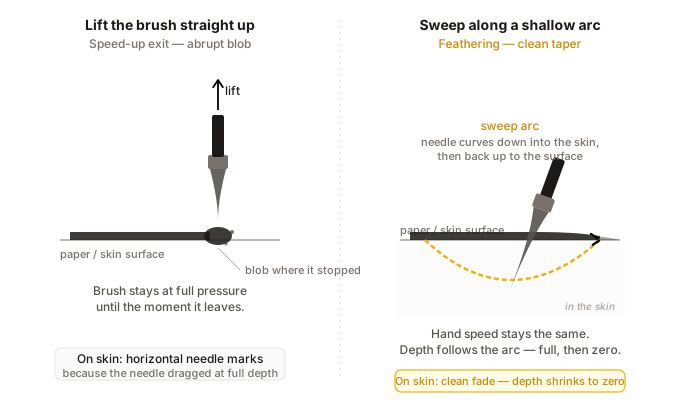
Your machine works the same way. Brush pressure is needle depth. The arc the brush travels is the sweeping motion. And the skid — the one you get from moving fast — is the horizontal needle mark.
What a sped-up exit actually does#
When you accelerate the hand on exit, the needle is still parked at dermis depth, still depositing pigment. The only thing that changed is that it is now traveling further sideways between each firing cycle.
So instead of dropping pigment evenly and creating a smooth gradient, your stroke creates horizontal streaks — lateral lines across the shaded field, running perpendicular to your stroke direction.
In plain mechanics terms, the needle's motion has two components: one pointing down into the skin — that is the depth. The other works on the 2D surface, like drawing. Feathering works by gradually shrinking the downward component — that is what the sweeping arc does. Speeding up does not touch the downward component at all. It works on the 2D surface only.
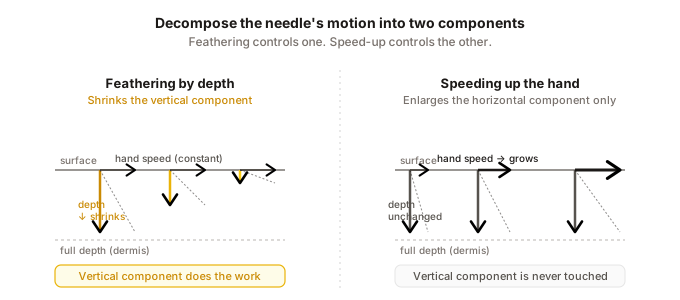
To be a good tattoo artist, you must understand the importance of skin depth and know how to incorporate that in each one of your techniques. A very common thing I see in the industry is that many artists talk about tattoo techniques from a 2D surface level — they borrow a concept or skill from drawing classes and simply apply it onto the skin, ignoring the fact that the skin is not a piece of paper. Simply using drawing skills on the skin would cause a lot of extra damage.
Why the marks are permanent#
Horizontal needle marks are pigment sitting in the wrong place. You cannot lift pigment back out with a tattoo machine. A second shading pass over the area does not dissolve the streaks — it just lays more pigment around them, together with more skin damage.
A common "skill" that is widely taught and spread in the industry is to go over the same piece of skin again and again, using a very light needle depth. People call it "building up the shade." This is a very bad practice because it comes straight from the fear of leaving those needle streaks, and the solution — going over the same area again and again and slowly building it up — is straight from the sketching drawing technique.
Why is it a bad practice? Because a piece of paper can take many layers of scraping, and you can build up on it within limits, but human skin cannot. Each time you go over the same area, you are causing more trauma to the skin, and the pigment will not be deposited as evenly — it gets messier and will show after the tattoo is healed.
Fresh, the marks hide well — after many passes of building up, there is extra ink left on the epidermis layer, which will hide the needle marks underneath. The work can look cleaner on the table than it actually is. Then it heals, and the streaks are still there. This is why looking at healed photos — yours and other people's — is worth more than looking at fresh ones. Healed work tells the truth.
To recap:
- The hand speeds up on exit because it is borrowing the whip-shading instinct, where speed is the right tool.
- In smooth shading, speed is the wrong tool — the needle stays at depth and drags sideways.
- Feathering lives in the depth of the machine, not the speed of the hand.
- The damage, horizontal needle marks, is permanent, and it hides until the tattoo heals.
Closing#
To wrap this up: speeding up your exit is not a gentler way to feather. It is whip shading happening by habit, in a place where whip shading does not belong, and it leaves marks you cannot take back. Feathering is depth control. Hold your hand speed steady and let the sweeping arc do the work.
The mechanism is the same on real skin — but you have less margin before an error becomes permanent. So build the sweeping motion until it is automatic on practice skin before you trust it on a person.
Horizontal streaks read as "something went wrong with the needle in the skin," so a lot of artists and apprentices spend months chasing depth settings, machine tuning, even needle gauges — while the actual cause sits in their hand. Knowing the mechanism is what lets you skip those months.