Key Points#
- Smooth shading is not a single technique. It is the result you see when several separate controls hold steady at the same time.
- The three basic controls for the foundation of smooth shading are constant hand speed, correct depth in the dermis, and gradual entry and exit. Any one of them drifting degrades the whole result.
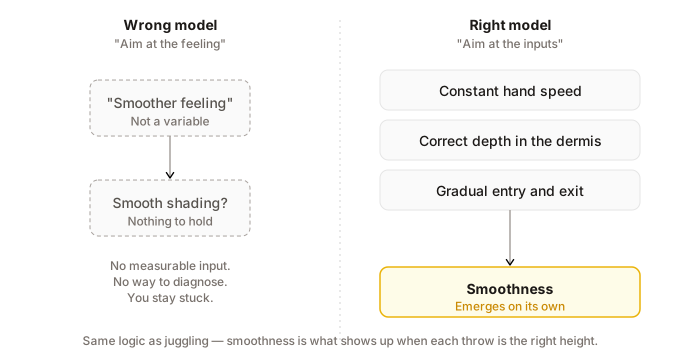
- Chasing a smoother feeling in your hand keeps you stuck, because a feeling is not a variable you can measure or correct.
- Feathering is taught after hand-speed practice on purpose. Your attention can only hold so many things at once.
- If hand speed is not automatic yet, adding depth control makes you unconsciously slow down — and a slow stroke overloads the skin with pigment.
In eight years of training apprentices, there is one question I get from aspiring tattoo artists more than almost any other: what is the actual technique for smooth shading? They are looking for a move — a thing to do with the hand that produces the smooth result.
Here is the honest answer, and it is not satisfying at first. There is not one. Smooth shading is not a single certain technique you perform. It is a result you produce, and to produce the result requires muscle memory for about ten things.
What "smooth" actually is#
Start with a clean definition. Smooth shading means a healed gradient where the tone moves continuously — no abrupt stops, no visible seams, no spots where the shade jumps from one density to another. Notice the word healed. Smoothness is judged weeks after the session, not on the table.
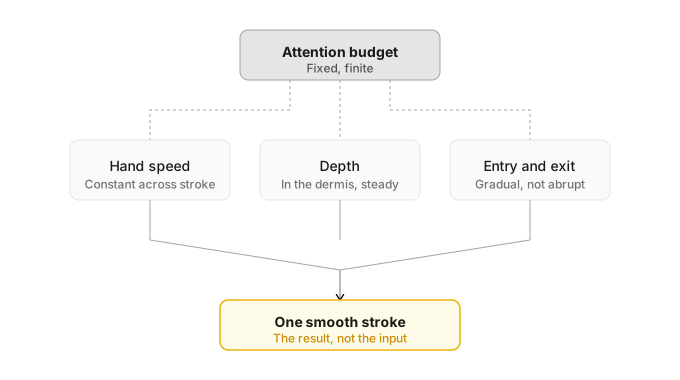
And it is not produced by any one motion. It is what you get when three separate things all stay under control at once: your hand moves at a constant speed, your needle stays at the right depth in the dermis, and your strokes enter and exit gradually instead of starting and stopping abruptly. Get all three and you will get one smooth stroke. Stack many of those strokes together, and you have a piece of smooth shading. The single stroke is where everything starts.
Why chasing the feeling keeps you stuck#
So why do so many artists stall out right here? Because they are trying to control the wrong thing.
When you treat smooth shading as a technique, you go looking for a feeling — some smoother, more flowing sensation in the hand that you can chase and reproduce. The problem is that a feeling is not a variable. You cannot measure it, you cannot check it against a baseline, and you cannot diagnose it when it goes wrong. You are left with a vague sense that this stroke felt better than that one, and no idea why.
Think of it like learning to juggle. Nobody learns to juggle by trying to juggle smoothly. Smoothness is not a thing you do — it is what shows up once each throw is the right height and your hands are loose. A beginner who focuses on looking smooth just tenses up and drops everything. The smoothness was never the input. It was always the output.
Smooth shading is the same. The inputs for one smooth stroke are hand speed, depth, and gradual entry and exit. Smoothness is the output. Aim at the output directly and you have nothing in your hands to actually hold onto.
The three controls, one at a time#
It is worth being concrete about what the three controls are, because "be aware of several things" is useless advice until you can name them.
- Constant hand speed. This is the focus of the previous lesson. The hand travels across the skin at one steady rate through the body of the stroke. Speed up partway and you thin the pigment out unevenly. Slow down and you pack it too dense.
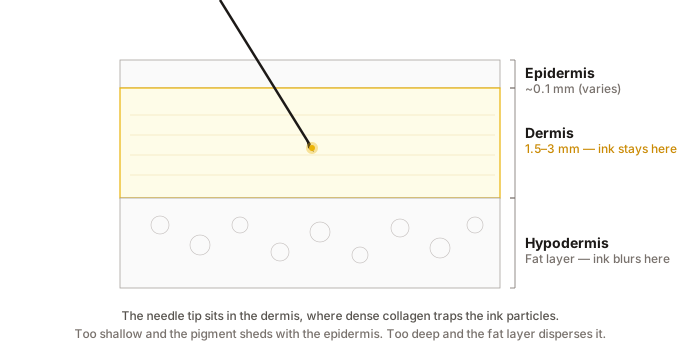
- Correct depth. The needle has to reach the dermis and stay there through the body of the stroke. Skin is three layers — the epidermis on top, the dermis in the middle, the hypodermis (the fat layer) below. The dermis runs about 1.5 to 3 millimeters thick depending on body location, and it is the only layer that holds a tattoo: its collagen is dense enough to trap ink particles, and its blood supply heals around them instead of rejecting them. Land too shallow, in the epidermis, and the pigment sheds as the skin turns over. Land too deep, in the fat, and the ink spreads and blurs.
- Gradual entry and exit. This is feathering. The needle arrives at and leaves full depth gradually, so strokes do not start or stop with a hard wall.
Each of these is its own skill, with its own failure mode, practiced in its own lesson. The reason smooth shading feels so hard is not that any single move is hard. It is that you are running three controls in parallel — and parallel is always harder than serial. All three of these only contribute to one single smooth stroke. Not to mention, you still have to combine all those single strokes together to make a whole piece of smooth shape.
Why feathering comes after hand speed#
This is where the juggling comparison earns its keep.
You cannot add a fourth ball to your juggling pattern until the three-ball pattern runs on its own — until you are not thinking about it. The same is true here. Feathering adds a second live control, depth graduation, on top of the constant hand speed you already have to maintain. If hand speed is not yet automatic — not yet handed off to motor memory — then you have to consciously watch it. And conscious attention is a fixed budget.
This is also why "check your hand speed from time to time" is not a throwaway note during feathering practice. It is a direct counter to a known, predictable failure.
Here is a composite of what I see often — not one specific student, but the same pattern, over and over. An apprentice has clean, confident lines and has just moved into shading. The first time they try to feather a shade, they are suddenly running two controls they have never had to separate before. Nothing is wrong with their hand. Their attention is just overbooked. The fix is not more effort. It is making one control automatic so the other one has room.
What this means for your practice#
The practical takeaway changes how you practice, not just how you think about it.
First: do not practice smooth shading. Practice the controls. Drill constant hand speed until it is boring and automatic — on fake skin, with the machine at 6.0 volts. Then add feathering on top — and while you do, keep auditing the speed. Every few strokes, ask whether it still matches your baseline from the speed lesson.
Second: practice awareness, not just repetition. Every stroke, you should be actively monitoring something specific — is the speed constant, and are there signs to show it being too fast or too slow? Catching the mistake in real time is how the correction sticks. Repeating strokes on autopilot just cements whatever you are already doing, right or wrong.
This is slower than chasing a feeling. It is also the only version that compounds.
To recap:
- Smooth shading is an output, not an input. The inputs for a single stroke are hand speed, depth, and gradual entry and exit.
- Chasing the feeling of smoothness gives you nothing to measure or correct.
- Feathering is sequenced after hand speed because attention is a fixed budget, and an overbooked budget makes you slow down without noticing.
- Practice the controls, and practice awareness — not the result.
Closing#
To wrap this up: smooth shading is not a technique, and the sooner you stop hunting for the move, the sooner you start improving. It is the result of a series of awarenesses held at once — hand speed, depth, gradual entry and exit, overlapping density, and more. Build them one at a time, make each one automatic before you stack the next, and the smoothness shows up on its own.
A caveat worth keeping: knowing this does not make it fast. It only takes a few minutes to understand why smooth shading works the way it does. It takes a long time of deliberate practice to actually do it well, and no article shortcuts that part. What the understanding buys you is direction — you will be practicing the right things. That is not something every self-taught path gets right, and it is worth more than it sounds.